Salesforce Population Segmentation With Rubric Rx
Not every applicant, prospect, or constituent should follow the same journey.
A prospective student who is highly engaged may need a different next step than someone who has not responded to recent outreach. An applicant with missing requirements should not receive the same communication as one who is ready for review. A scholarship candidate who meets key eligibility criteria belongs in a different population than someone who needs additional information.
Salesforce contains the data teams need to recognize those differences. The challenge is turning multiple data points, institutional priorities, and business rules into populations people can actually use.
Rubric Rx helps institutions identify, rank, and segment populations directly in Salesforce. By combining multiple factors into configurable scoring and ranking models, teams can move from complex data to clear groups, personalized communications, and more appropriate next steps.
Why meaningful population segmentation can be difficult
Basic segments are easy to create. A list based on one field, such as program interest or application status, may be enough for a simple campaign. However, the populations that matter most often depend on several conditions at once.
A recruitment priority might consider geography, academic interest, engagement, event participation, and application progress. Scholarship eligibility may depend on program, enrollment status, academic information, financial criteria, and completed requirements. Applicant review order may combine completeness, deadlines, institutional priorities, and related-record data.
The logic can quickly move into spreadsheets, one-off automations, or custom development. Those approaches may work, but they can be difficult to maintain when priorities change. They can also make it harder for staff to understand why a person entered a group or received a particular ranking.
Turn complex Salesforce data into actionable populations
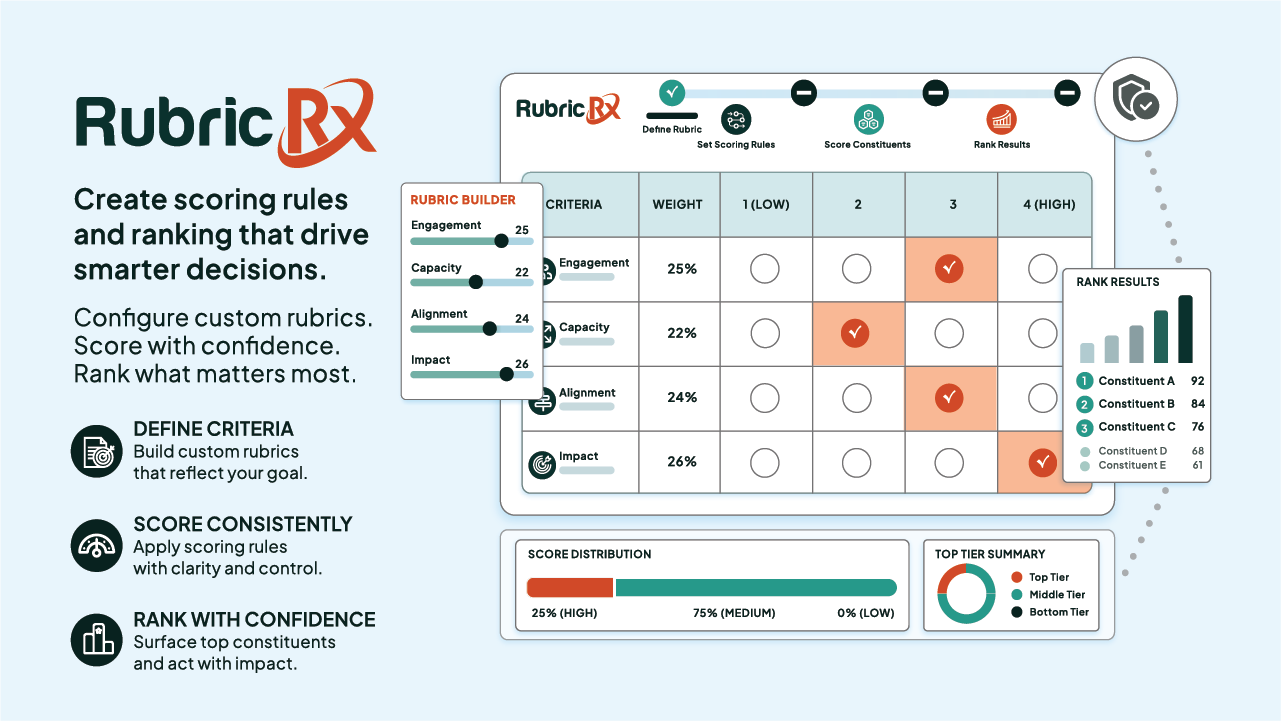
Rubric Rx provides a configurable scoring framework inside Salesforce. Administrators can combine rule groups, weighted criteria, condition logic, deductions, grade bands, and ranking methods to reflect the factors that matter to their institution.
Each model can evaluate data on the primary record and related Salesforce records. Rubric Rx can then calculate a score, assign a grade or category, rank records, and show which criteria contributed to the result.
The outcome is more than a number. Scores, grades, and rankings can be used to create actionable populations for communications, journeys, staff assignments, review queues, reporting, and Salesforce Flow.
Work with your existing Salesforce data model
Every Salesforce org is different. Institutions use different objects, fields, relationships, and processes based on how their teams work and how their Salesforce environment has evolved.
Rubric Rx is designed to work with that existing structure. Because the framework is object-agnostic, teams can apply scoring and ranking logic to standard or custom objects without redesigning the data model around the application.
That flexibility matters. Teams can build population models around the data they already collect, incorporate information from related records, and update the criteria as institutional priorities change. Rubrics can also be recalculated in batch, allowing an updated model to be applied consistently across a full population.
Six ways to use Rubric Rx populations
1. Prioritize high-value recruitment prospects
Combine program interest, geography, engagement, event activity, inquiry history, and other institution-defined factors. Recruitment teams can use the resulting score or ranking to focus attention while still considering the context behind each record.
2. Identify applicants who need additional outreach
Evaluate application progress, missing materials, deadlines, communications, and related requirements. Rubric Rx can help distinguish applicants who are ready for review from those who may benefit from a reminder or personal follow-up.
3. Create personalized communications and journeys
Use grades, categories, or score ranges to organize people into meaningful groups. Salesforce Flow and connected communication tools can then support different messages and next steps based on each population.
4. Determine scholarship or program eligibility
Combine required qualifications with weighted institutional priorities. Rubric Rx can identify eligible populations, flag records that need review, and show which criteria passed, failed, or affected the score.
5. Rank applications for review
Score completed applications against consistent criteria, then use rankings and tie-breakers to organize review. The ranking supports the process without replacing the judgment of reviewers or decision-makers.
6. Qualify and prioritize leads
Apply the same configurable framework beyond higher education recruitment. Teams can evaluate fit, readiness, engagement, and related activity on Lead records or other standard and custom Salesforce objects.
From segment to next action
Segmentation becomes valuable when it changes what happens next. A score can help identify a population, but the real goal is to give each person a more relevant experience and help staff focus their time.
For example, one population might enter a high-touch recruitment journey. Another might receive information about a specific program. Applicants with missing requirements could receive targeted reminders. Eligible scholarship candidates could move into a review process. High-priority leads could be assigned for immediate follow-up.
Because the results remain in Salesforce, teams can report on the populations, use them in automation, and refine the model as results and priorities change.
Keep people in control of the process
Rubric Rx helps teams apply complex criteria consistently, but it does not need to make the final decision. Human judgment still matters in admissions, scholarships, outreach, qualification, and other processes where context and exceptions are important.
Transparency makes that balance possible. Staff can review the criterion-level breakdown and the underlying Salesforce data instead of relying on an unexplained score. They can understand why a record entered a population, determine whether additional review is needed, and make the final decision with better context.
Give each population a more appropriate experience
Treating every record the same may be simple, but it rarely reflects the people, priorities, or processes behind the data.
Rubric Rx gives teams a configurable way to identify, rank, and segment Salesforce populations using the criteria that matter to them. The result is a clearer way to determine who should receive what experience, which records need attention, and what should happen next.
For a product introduction, read Meet Rubric Rx: https://www.enrollmentrx.com/meet-rubric-rx/
Explore Rubric Rx and its capabilities: https://www.enrollmentrx.com/rubric-rx/