Transcript evaluation often becomes a visibility problem before it becomes an automation problem.
A document arrives. Someone opens it in one system. Course data is reviewed somewhere else. Equivalencies live in another process. Then the final decision has to make its way back into Salesforce.
Each handoff creates another opportunity for delay, rework, or uncertainty. More importantly, institutions can lose control of the rules that determine what happens next.
With Agentforce as the AI layer, AI transcript evaluation in Salesforce offers a different model. The goal is not to remove people from the process. The goal is to keep the work, the rules, the exceptions, and the final records connected inside the environment the institution already uses.
Why transcript evaluation is hard to control
Transcript evaluation involves more than reading a PDF.
Staff need to confirm that the document belongs to the right student. They need to verify academic history, course names, numbers, grades, terms, and credits. Next, they may need to compare that information with existing records and match courses to an equivalency catalog.
The routine work is substantial. However, the exceptions are where institutional judgment matters most.
A course number may be unclear. A student name may not match the linked record. An equivalency may not exist yet. A policy may change. The institution still needs a consistent way to review the issue, document the decision, and preserve the result.
When transcript processing happens outside Salesforce, these decisions can become disconnected from the student record. Staff may have to move data manually or rely on a process that is difficult to adjust when institutional policies change.
How Agentforce supports AI transcript evaluation in Salesforce
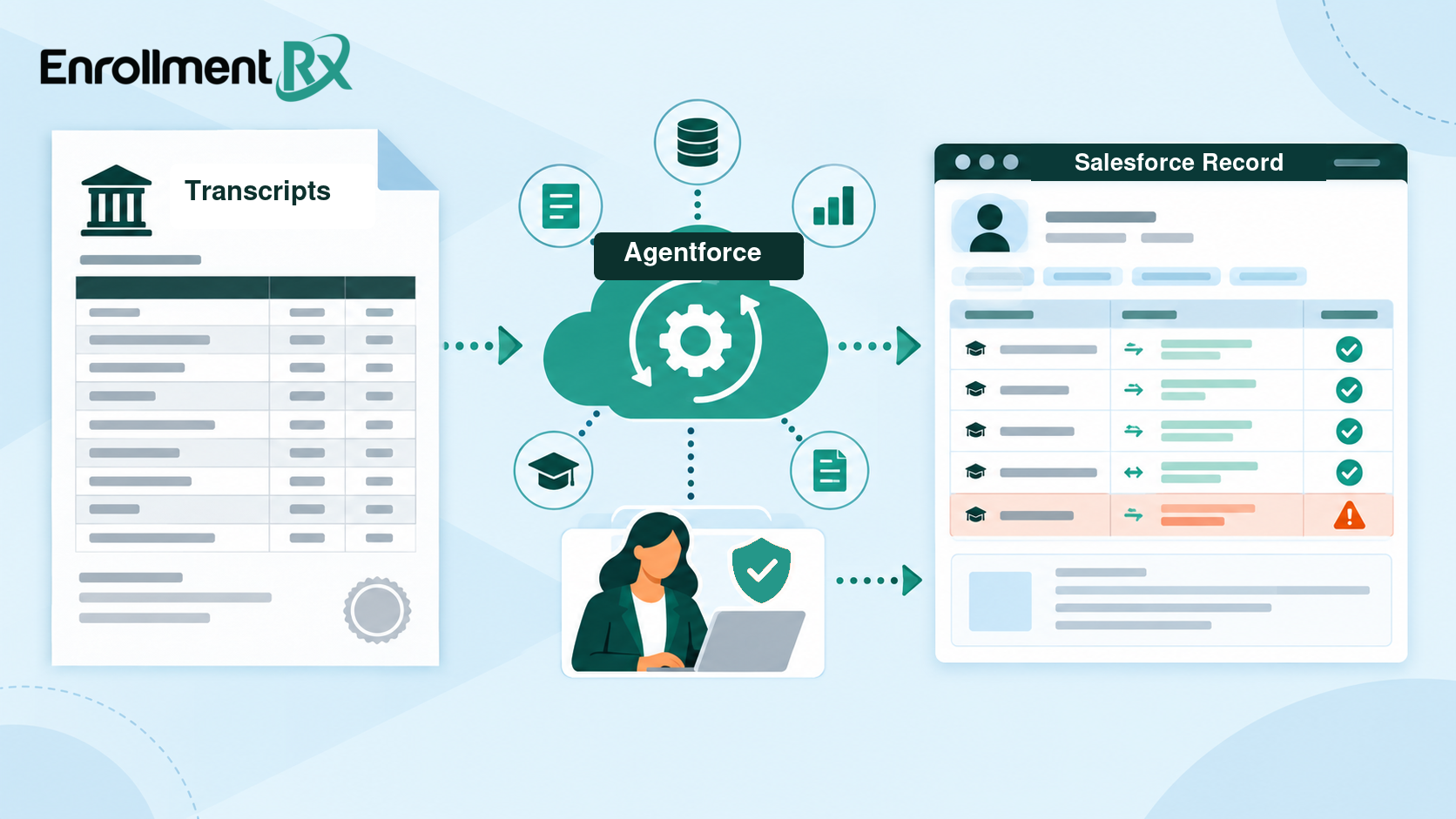
EnrollmentRx has built an Agentforce transcript-processing solution on Salesforce. Agentforce provides the AI layer that reads transcript documents and returns structured academic and course data. The solution then guides the work from intake to final Salesforce records.
A transcript can arrive through a student portal, a staff upload, or an integration. Because the intake process begins when the file reaches the Salesforce record, each channel can follow the same path.
Agentforce extracts the academic and course data into a structured format. The process can then compare the extracted identity with the linked student and institution. It also assigns a confidence score so the institution can decide which transcripts are ready for review and which need closer attention.
From there, a reviewer can work through four practical stages:
- Verify the extracted transcript and course data.
- Compare transcript values with the current Salesforce record.
- Match courses to the institution’s equivalency catalog.
- Finalize the review and create structured transfer course records.
This approach keeps the source document, extracted information, reviewer decisions, and final records connected.
For institutions already using Agentforce, transcript evaluation is a practical way to extend it into a high-value operational workflow. For institutions looking to start using Agentforce, it offers a focused use case with clear inputs, safeguards, review points, and structured outcomes.
Confidence thresholds support responsible automation
Agentforce can reduce repetitive work, but institutions still need control over when automation is appropriate.
That is why confidence thresholds matter. An institution can set the level required for a transcript to continue through an automated path. High confidence work can move ahead according to the institution’s configuration. Anything below the threshold can wait safely for a reviewer.
The automation choices can also be separated. One institution may automate intake and extraction while requiring human review for every transcript. Another may allow high confidence evaluations to complete with less intervention.
This is a practical distinction. Responsible automation is not a single on or off decision. It is a set of choices about where people add value, where the system can handle routine work, and what conditions should trigger review.
Reviewers need the document and the data together
Transcript review becomes easier when staff do not have to move between disconnected screens.
In the EnrollmentRx workflow, the original document appears beside the extracted information. Reviewers can confirm student details, academic history, and each course while keeping the source in view. They can correct extracted values, verify courses individually, or accept a group when the information is clear.
Identity checks add another safeguard. If the name on the document does not align with the linked Contact, the system can surface a warning before the evaluation moves forward.
The point is not to assume Agentforce will always be right. The point is to make verification faster, clearer, and more consistent.
Field mapping should reflect the institution’s Salesforce model
Different institutions store academic history in different ways. Therefore, transcript processing should not depend on one fixed object or one fixed set of fields.
EnrollmentRx’s approach is object agnostic. Administrators can configure the target object, identify the relevant student and institution fields, and choose which reviewed transcript values can map to their Salesforce records.
During review, staff can see what the transcript says alongside what Salesforce currently contains. They can choose which values should be applied. Nothing has to write to the final record until the evaluation is finalized.
That control matters when institutions have established data standards, custom objects, or different review requirements.
Course equivalencies improve with each decision
Course matching is another area where automation and institutional judgment need to work together.
The process can look for equivalencies using institution-defined matching fields, such as course number or course name. When a match is clear, it can be presented to the reviewer. When no match exists, staff can search the catalog, select a different result, or create a new equivalency.
Reviewer decisions remain authoritative. In addition, each resolved exception can strengthen the institution’s equivalency catalog for the next transcript from that school.
Over time, routine matches become easier while unusual cases remain visible.
Finalization creates usable Salesforce records
The value of transcript evaluation is not the extracted text. It is the structured, traceable record that the institution can use afterward.
At finalization, the process can create transfer course records linked to the student, transcript evaluation, institution, and course equivalency. It can also apply the field mappings selected during review.
That creates a cleaner handoff to advising, admissions, enrollment services, or any downstream process that depends on evaluated academic history.
Because the records remain in Salesforce, staff can follow the decision back to the evaluation and the source document. They can also use the data in workflows, reporting, and communications without another manual transfer.
Control is the real benefit
The strongest case for AI transcript evaluation in Salesforce is not speed alone.
It is the ability to define the process around institutional policy. Schools can decide how transcripts arrive, which fields matter, what confidence level is acceptable, how courses are matched, when people review the work, and where the final records belong.
Automation can handle more of the routine path. At the same time, reviewers retain control of exceptions and final decisions.
That balance can help institutions reduce repetitive work without turning over the logic that shapes transfer credit and academic history.
Learn more about EnrollmentRx products at https://www.enrollmentrx.com/products/.
To discuss how an Agentforce-powered, institution-controlled transcript evaluation workflow could fit your Salesforce environment, schedule a conversation at https://erx-demo.youcanbook.me/.